In concert with our Healthcare Education & Training committee comprised of health and medical industry professionals, our own Dr. Trish Hurford MD, MS has gathered a variety of cited best practices for effectively using cannabis for health, wellness and longevity.
Cannabis is increasingly studied for its potential role in health maintenance and long-term wellness, beyond intoxicating use. In wellness-oriented approaches, the emphasis is placed on supporting physiologic balance, moderating inflammation, improving sleep quality, protecting neurologic function, and supporting metabolic health.1,3
The below simple and straight forward tips can ensure improved personal wellness by supporting ECS (Endocannabinoid System) function, immune function, reducing inflammation, sleep, stress and hormone regulation, metabolism and weight support as well as pain management and mobility.
This comprehensive Cannabis for Wellness resource, is an excellent tool for Budtenders looking to confidently speak to cannabis as part of a balanced, wellness-focused lifestyle. Grounded in cited research and practical best practices, it provides retail teams with clear guidance on the endocannabinoid system, inflammation support, sleep, metabolism, and responsible dosing strategies. Retail leadership is strongly encouraged to download the PDF version and incorporate it into ongoing staff training to ensure your team is equipped to educate consumers thoughtfully and responsibly. Click the button below to download your copy and strengthen your in-store wellness education today.
Download The Budtender Information Sheet Here

The human body contains an intrinsic regulatory network known as the endocannabinoid system (ECS), which plays a role in modulating mood, pain perception, appetite, sleep, immune activity, and stress responses.4, 5, 6 The ECS consists of cannabinoid receptors (CB1 and CB2), endogenous cannabinoids such as anandamide and 2-arachidonoylglycerol, and enzymes responsible for their synthesis and degradation.4,5
The primary wellness goal is to support ECS function to promote physiologic balance and adaptive stress responses.
This may be approached through:
- Low-dose phytocannabinoids, such as cannabidiol (CBD) and very small amounts of tetrahydrocannabinol (THC), which interact with ECS signaling pathways7, 8, 9
- Additional plant-derived cannabinoids (e.g., CBG, CBN, THCV), which demonstrate biologic activity in preclinical and early translational research10, 11, 12
- Lifestyle practices—including regular physical activity, adequate omega-3 fatty acid intake, intermittent fasting, and cold exposure—that are associated with endogenous endocannabinoid production and signaling6, 13, 14, 15

Chronic low-grade inflammation is associated with accelerated aging, chronic pain, and the development of multiple long-term diseases.16,17 Cannabinoid signaling is closely linked to immune regulation and inflammatory control.
Several cannabinoids, including CBD, CBG, CBN, and THC, have demonstrated immunomodulatory and anti-inflammatory effects through actions on immune cells and inflammatory signaling pathways.18,19,20,21 Other plant compounds, such as THCV and cannabichromene (CBC), may further influence these pathways, potentially enhancing overall effects.10,11 Full-spectrum preparations contain multiple cannabinoids and plant constituents that may act synergistically, a concept supported by pharmacologic and preclinical research.22
Potential mechanisms include:
- Reduction of pro-inflammatory signaling molecules
- Modulation of overactive immune responses
- Support of tissue recovery and repair
- Indirect immune benefits through improved sleep and stress regulation6, 19
Common wellness applications include joint and muscle discomfort, chronic pain syndromes, gastrointestinal inflammation, and post-exercise recovery.18, 23

Aging of the nervous system is influenced by neuroinflammation, oxidative stress, and reduced synaptic resilience.24, 25 Cannabinoid signaling has been shown to affect neuroprotection and neural plasticity.
Preclinical and translational studies suggest that:
- Certain cannabinoids reduce oxidative and inflammatory injury to neurons24, 25, 26
- CBD may support neurogenesis and synaptic function27, 28
- Very low doses of THC may improve cognitive flexibility and memory performance in older adults, based on animal and early human data.29
Common wellness goals include supporting focus and memory, reducing anxiety, protecting against neuroinflammation, and stabilizing mood and circadian rhythms.25, 26, 27, 29

Adequate sleep and effective stress regulation are essential components of long-term health and longevity. ECS signaling interacts with circadian rhythms, sleep architecture, and stress hormone regulation.30, 31, 32
Evidence suggests:
- CBD may reduce stress-related hormonal activation and anxiety31, 33
- CBN and selected plant constituents may support sleep initiation and maintenance30,34
- Very low doses of THC administered at night may improve sleep latency in some individuals34
Common wellness goals include supporting focus and memory, reducing anxiety, protecting against neuroinflammation, and stabilizing mood and circadian rhythms.25, 26, 27, 29

The ECS plays a role in appetite regulation, energy balance, lipid metabolism, and insulin signaling.36, 37 Dysregulation of ECS activity has been associated with obesity and metabolic disease.
Compounds of interest include:
- THCV, which has been studied for appetite modulation and glycemic effects38
- CBD, which may influence mitochondrial function and cellular energy metabolism39
- CBG, which shows early evidence for effects on lipid metabolism11
A common conservative approach includes morning use of THCV-dominant formulations for appetite and focus, with CBD used during the day to support metabolic balance.38, 39

Effective pain management supports mobility, physical activity, and overall longevity. Cannabinoids may reduce pain through central and peripheral mechanisms.
Common delivery approaches include:
- Topical formulations for localized joint or muscle discomfort40
- Oral preparations for longer-acting systemic pain modulation23
- Low-dose inhaled THC for episodic pain flares, when appropriate41

Cannabis-based strategies are most effective when integrated with broader lifestyle and medical approaches. Evidence supports complementary use alongside fasting or carbohydrate-restricted nutrition, mitochondrial-supportive supplements, adaptogenic botanicals, and selected immune-modulating therapies.14, 16, 36
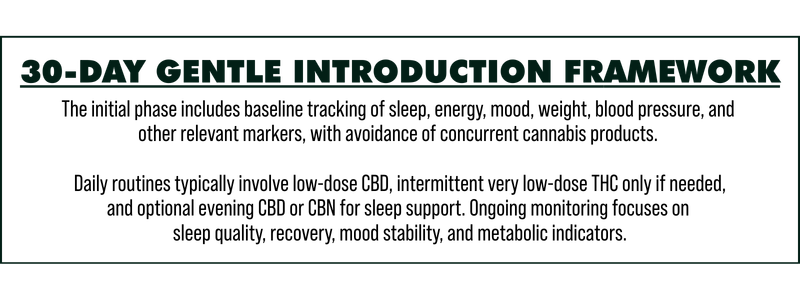
Wellness-oriented dosing emphasizes:
- Initiating at very low doses
- Gradual titration based on response
- Avoiding intoxication as a goal
- Monitoring sleep, cognition, cardiovascular parameters, and energy
Safety considerations include avoiding THC in individuals with a history of psychosis or significant arrhythmias, exercising caution with medications affecting hepatic metabolism, and monitoring for orthostatic symptoms in older adults.41, 42, 43